Showing posts with label Latin America. Show all posts

Saturday, October 30, 2010

Tres Leches Cake

I have been fascinated with Tres Leches Cake since moving to Austin. It has a wonderful flavor, and unfortunately tons of calories.

My mother's birthday is November 2, so we discussed the kind of birthday cake she wanted. I mentioned Tres Leches and she had never heard of it...so I thought it would be a good occasion to introduce her to it. We are celebrating this weekend, so I purchased the cake (you can see it on the left) from Whole Foods.

I associated this cake recipe with Mexico, but now I have discovered that it is common in many parts of Latin America, not just Mexico. In Austin, it commonly has the meringue frosting that you see in the pictures, but in Latin America it is topped with fruit and many other flavorings.

I found a wonderful article about the history of Tres Leches Cake at http://www.austinchronicle.com/gyrobase/Issue/story?oid=oid:196888. These cakes are quite popular in Austin these days, and once you taste one you will understand the reason!!

Tuesday, October 26, 2010

Cassava: A Lesson in Human Ingenuity!

Sometimes it amazes me that certain plants have become food! Cassava, for example, has been domesticated for 8-10,000 years. But cassava contains cyanogenic glucosides which become hydrogen cyanide. The cyanide combines with hemoglobin making it unable to carry oxygen to tissues.

Cassava was most likely first domesticated by people near the southern border of Brazil, however early evidence of its use in Central America has also been found.

Portuguese explorers found people using cassava as a staple when they visited South America. As the explorers participated in the slave trade, they introduced the crop to Africa in about 1550. From the slave trading stations near the mouth of the Congo River, cassava soon spread to all of central Africa. The Portuguese also spread cassava to East Africa, Madagascar, India, Ceylon, Malaya, and Indonesia by the 1700s.

image from blog.terramadre.org/index.php/kubrick/2006/09/P10/
The people found using cassava in South America were the Tupinamba. They processed the tubers into meal and bread using techniques similar to those still used today. These techniques remove the dangers from cyanogenic glucosides.

But how did the people figure this out? Human ingenuity? We may never know, but we can use their preparation techniques to protect ourselves from the dangers.

Peeling the tuber is the first line of defense because most of the cyanogenic glucosides are found in the tuber skin. Pulping the tuber is another method of detoxifying the cassava. In pulping, the peeled tuber is grated and crushed, pressing most of the water and toxins out of the pulp. Boiling can also remove the toxicity.

Cassava varies in bitterness depending on growing conditions and the genetics of the individual plant. Higher contents of cyanogenic glucosides correspond to more bitter tasting cassavas.

Amounts of cyanogenic glucosides in cassava are:
–Sweet Cassava 40-130ppm
–Non-Bitter Cassava 30-180ppm
–Bitter Cassava 80-412ppm
–Very Bitter Cassava 280-490ppm
where ppm is parts per million and concentrations less than 50 ppm are considered safe.


Most cassava tubers sold in grocery stores in the United States is sweet cassava. Bitter cassava is often processed into flour, with the toxins removed during processing. However, in some tropical nations some people eat bitter cassava if they have no other food. These people can suffer neurological disorders and other problems if they do not prepare the cassava properly. Over 500 million people in the world depend on cassava as their main calorie source.


More information about cassava can be found at
http://researchnews.osu.edu/archive/cassava.htm and

Sunday, September 5, 2010

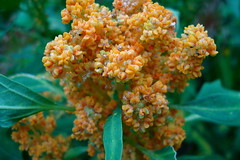
Ancient Grains: Quinoa

photo courtesy of net_efekt
Quinoa, like amaranth is not technically a grain because it is not a grass. Quinoa seeds however are ground and uses as grains. Amaranth is grown in warm areas or seasons, whereas quinoa is grown in cold areas or seasons. 

The origin of quinoa is probably the Altiplano region of Peru or Bolivia about 3000 years BCE. The ancient Incas called it la chisiya mama which means the mother grain. The first sowing of the season was a ceremony in which the Inca Emperor planted the first seeds with a gold shovel. The Incas mixed quinoa with animal fat and made balls that they called "war balls." The men would take them on marches as nutritious food. This seems reminiscent of the use of pemmican by the Commanches.

The Spanish conquerors did not like quinoa, possibly because the seed coat contains saponins, which are bitter. Saponins are easily removed by rinsing the grains, but the bitterness mixed with quinoa's sacredness to the Incas caused the Spanish to discourage its production. Instead, they encouraged corn production and quinoa became much less common. 

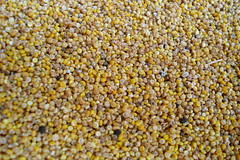
Quinoa color varies from off-white to red to black and it contains all nine essential amino acids. Also, quinoa is a good source of manganese, magnesium, iron, copper, and phosphorus, and a moderate source of zinc, potassium, B vitamins, and vitamin E. Quinoa is easy to digest and a good source of fiber. 

People often snack and overeat because when they eat certain foods their blood sugar level abruptly spikes and declines making them hungry again quickly. Quinoa has a low glycemic index therefore the uptake of sugars is regulated and slower, therefore the eater has a ‘full’ feeling longer. So quinoa can help you avoid between-meal-snacks. Also, quinoa is healthy for our hearts and has only about 159 calories per serving.