Saturday, November 24, 2012

Axel Munthe's Love Affair with Capri

Who could not be in love with an island as enchanting as Capri? However, few of us are lucky enough to be able to live there ... even part-time.

Axel Munthe was one of the lucky ones, building his home, Villa San Michele, on the site of a Roman Villa in the town of Anacapri.

He wrote a book called "The Story of San Michele" which is a charming collection of vignettes about people and places from his life. Villa San Michele plays a starring role in the book, and Dr. Munthe is not shy about expressing his passion for her magic.

He relates the story of his first encounter with San Michele...and the thunderbolt of her impact on him. For many years afterward he dreamed of owning her, and once he became a psychiatrist and married an English aristocrat, he was able to realize his dream.


Once you enter the front door and beware of the dog (Munthe was actually an animal lover who kept numerous dogs) you notice that many antiquities are incorporated into the structure. Some of them may have been recovered from the original Roman villa on the site, but others may have been brought to the site from other places.


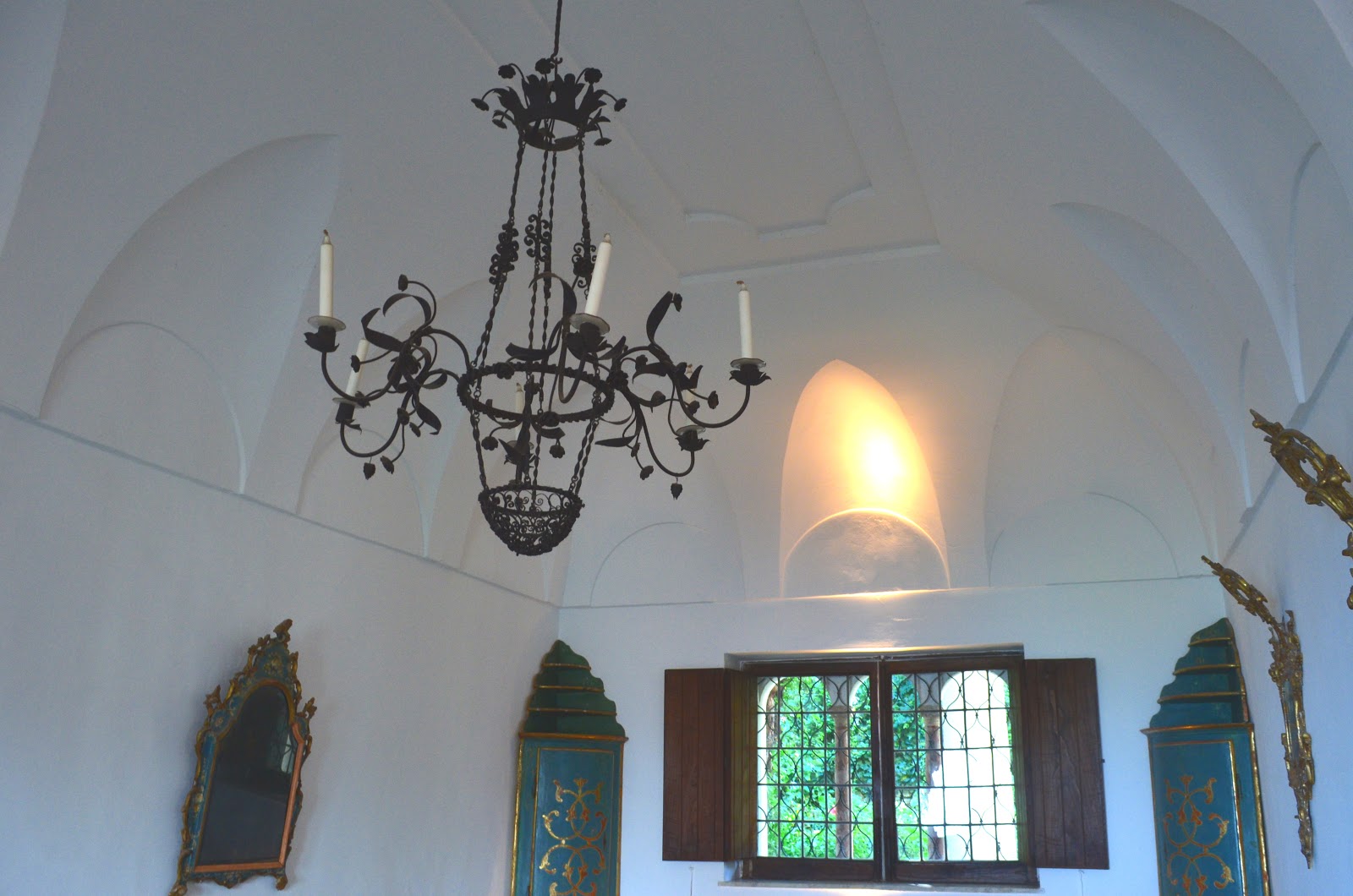
The home has Gothic elements and Axel Munthe himself was heavily involved in the design and renovation of the property.

Although the interior is luxurious and beautiful.....


the most spectacular part of San Michele is the garden.


You reach the garden through an art-filled portico...


And your reward is a spectacular view of the sea.


Facing east toward sunrise is a special treat, the granite sphinx. Its origins are unknown, but it is thought to be Egyptian and perhaps Axel Munthe acquired it from a Roman Villa. It had to be transported up the approximately 700 Phoenician steps to the elevation of 327 m. because there was no road at the time. The Greeks carved the steps into the dolomite cliff face, and they are narrow and steep, so it must have been quite a chore!


The image below shows a bust of Axel Munthe in front of a pomegranate tree.


A splendid surprise at the edge of the garden is a small chapel.


Axel Munthe's motto was "Live unafraid, trust in life!" and that he certainly did!!!

More information about Axel Munthe and San Michele can be found at http://www.villasanmichele.eu.


An Ode to Anacapri


The winding road guided us on a breathtaking journey through the Isle of Capri to the town of Anacapri, perched on a mountainside overlooking the azure sea. Before the road was built, the only way to reach Anacapri was by La Scala Fenicia, the Phoenician Steps. The Greeks (not the Phoenicians) probably created the steps, which were carved from the dolomite cliff face leading from the areas of the Grand Marina to San Michele...involving an elevation change of about 327 meters. 


Our first stop was a visit to a man who showed us how they made inlaid furniture, a trade with a long history in the town. The table in the picture is a game table, filled with hidden compartments and inlaid game boards. The beauty and precision of their work is astounding! We then walked along the path to San Michele, encountering the treasures that you see in the photographs below.


A poem on one wall intrigued me, so I translated it using "Google Translate." The translation is below the poem's image. Let me know if the translation in not accurate. I find the poem to be lovely and expressive of the ambiance of this special island! I wanted to stay there forever!!!!


We sing to you, green Anacapri, tell you that silence closes like a vest;
Sing the peace that flows in you like blood, sweet and kind, without disturbance.
Tell the broom plant that crowns the mountain who is grateful for the ilex shade in the afternoon,
Tell the prickly pear, which offers open palms to the stigmata of the sun.

But now and later:
The day already declines and the mountains are blue shadows.
Feel that slight chirp of birds, hiding low in the bushes?
It is late now: you need to go,
There is already a bit of a Tiberius moon, just a comma, and the new moon, one more time ...
Now I decide to go that way between the mountains and the sea and I'm going to accompany a firefly.

Alma Syracuse Vuotto

Additional information about Capri can be found at


Monday, November 19, 2012

Pompeii


I spur my horse past the ruined city;

by Han-shan (Cold Mountain)

English version by Burton Watson
Original Language Chinese

I spur my horse past the ruined city;
the ruined city, that wakes the traveler's thoughts:
ancient battlements, high and low;
old grave mounds, great and small.

Where the shadow of a single tumbleweed trembles
and the voice of the great trees clings forever,
I sigh over all these common bones --
No roll of the immortals bears their names. 


Sunday, November 18, 2012

Palermo: City of Contrasts


Situated next to a stunning harbor and surrounded on three sides by mountains, Palermo reflects the influences of the many invaders that have coveted her strategic Mediterranean location.


The Palermo Cathedral shows many of those influences, having been built by the Normans in the 12th century on the site of a Byzantine basilica and subsequent mosque. Many additions were added reflecting the changed times, until the 18th century when a major renovation occurred. Norman and Arabic influences can be felt throughout the cathedral. We were lucky to be in the cathedral during a wedding.


In front of the cathedral is a float with a statue of Santa Rosalia, the patron saint of Palermo. Rosalia's body was found in the region around Palermo, and when it was brought through the city, many people were cured of the plague...so Palermitans believe it was a miracle, and in the summer there is a festival each year in her honor. The float and stature of Santa Rosalia are the centerpiece of a parade during the festival.


The Cathedral at Monreale is in the mountains around Palermo, and the image above shows part of it. This cathedral is know for its spectacular mosaics.

\
The Sicilian Parliament meets in the Norman Palace which was also the seat of government when the Normans ruled Sicily. The details of this palace also demonstrate the cultural fusion that is Sicily.


The street markets of Palermo are interesting.


Additional photos of Palermo are shown below.